45 shuffle data and labels python
Python - How to shuffle two related lists (training data ... answered Oct 21, 2019 by pkumar81 (45.3k points) You can try one of the following two approaches to shuffle both data and labels in the same order. Approach 1: Using the number of elements in your data, generate a random index using function permutation (). Use that random index to shuffle the data and labels. >>> import numpy as np python - Get labels from dataset when using tensorflow image ... Nov 04, 2020 · The tf.data.Dataset object is batch-like object so you need to take a single and loop through it. For the first batch, you do: for image, label in test_ds.take(1): print (label) I used test_ds from your code above because it has the data and labels all in one object. So the take away is that tf.data.Dataset object is a batch-like object.
Shuffle an array in Python - GeeksforGeeks Shuffle an array in Python - GeeksforGeeks Shuffle an array in Python Last Updated : 05 Sep, 2021 Shuffling a sequence of numbers have always been a useful utility, it is nothing but rearranging the elements in an array. Knowing more than one method to achieve this can always be a plus. Let's discuss certain ways in which this can be achieved.

Shuffle data and labels python
How to Programmatically Label Datasets using Snorkel in Python To label datasets we will see how to use the labeling function feature of snorkel to programmatically label an unlabeled datasets. The basic workflow when working with snorkel is as below. In our case we have some datasets consisting of questions and quotes. Our task as data scientists is to label them as questions or not or questions or quotes. Python Examples of numpy.long - ProgramCreek.com The following are 30 code examples for showing how to use numpy.long().These examples are extracted from open source projects. You can vote up the ones you like or vote down the ones you don't like, and go to the original project or source file by following the links above each example. Python Shuffle List | Shuffle a Deck of Card - Python Pool Python Shuffle a List Using shuffle() Function. The shuffle() function in Python random module can be used to shuffle a list.. Shuffling is performed in place, meaning that the list provided as an argument to the shuffle() function is shuffled rather than a shuffled copy of the list being made and returned.
Shuffle data and labels python. Dataset Splitting Best Practices in Python - KDnuggets Thankfully, the train_test_split module automatically shuffles data first by default (you can override this by setting the shuffle parameter to False ). To do so, both the feature and target vectors ( X and y) must be passed to the module. You should set a random_state for reproducibility. Python | Ways to shuffle a list - GeeksforGeeks Method #1 : Fisher-Yates shuffle Algorithm This is one of the famous algorithms that is mainly employed to shuffle a sequence of numbers in python. This algorithm just takes the higher index value, and swaps it with current value, this process repeats in a loop till end of the list. Python3 # Python3 code to demonstrate # shuffle a list DICOM Processing and Segmentation in Python – Radiology Data ... Jan 05, 2019 · Processing raw DICOM with Python is a little like excavating a dinosaur – you’ll want to have a jackhammer to dig, but also a pickaxe and even a toothbrush for the right situations. Python has all the tools, from pre-packaged imaging process packages handling gigabytes of data at once to byte-level operations on a single voxel. 11 Amazing NumPy Shuffle Examples - Like Geeks Let us shuffle a Python list using the np.random.shuffle method. a = [5.4, 10.2, "hello", 9.8, 12, "world"] print (f"a = {a}") np.random.shuffle (a) print (f"shuffle a = {a}") Output: If we want to shuffle a string or a tuple, we can either first convert it to a list, shuffle it and then convert it back to string/tuple;
Shuffling Rows in Pandas DataFrames | by Giorgos ... The first option you have for shuffling pandas DataFrames is the panads.DataFrame.sample method that returns a random sample of items. In this method you can specify either the exact number or the fraction of records that you wish to sample. Since we want to shuffle the whole DataFrame, we are going to use frac=1 so that all records are returned. PyTorch DataLoader shuffle - Python PyTorch DataLoader shuffle - Python PyTorch DataLoader shuffle I did an experiment and I did not get the result I was expecting. For the first part, I am using 3 1 trainloader = torch.utils.data.DataLoader(trainset, batch_size=128, 2 shuffle=False, num_workers=0) 3 Python | Shuffle two lists with same order - GeeksforGeeks Method : Using zip () + shuffle () + * operator In this method, this task is performed in three steps. Firstly, the lists are zipped together using zip (). Next step is to perform shuffle using inbuilt shuffle () and last step is to unzip the lists to separate lists using * operator. import random test_list1 = [6, 4, 8, 9, 10] Pandas Shuffle DataFrame Rows Examples - Spark by {Examples} By using pandas.DataFrame.sample() method you can shuffle the DataFrame rows randomly, if you are using the NumPy module you can use the permutation() method to change the order of the rows also called the shuffle. Python also has other packages like sklearn that has a method shuffle() to shuffle the order of rows in DataFrame 1. […]
Shuffle in Python - Javatpoint Shuffle in Python. Shuffling refers to the rearranging of elements in a random order which means no specific sequence is considered while arranging the elements.. In this tutorial, we will learn how we can shuffle the elements of a list using Python. The different approaches that we will use to shuffle the elements are as follows- Python Random shuffle() Method - W3Schools The shuffle () method takes a sequence, like a list, and reorganize the order of the items. Note: This method changes the original list, it does not return a new list. Syntax random.shuffle ( sequence, function ) Parameter Values More Examples Example You can define your own function to weigh or specify the result. python randomly shuffle rows of pandas dataframe Code Example python randomly shuffle rows of pandas dataframe. # Basic syntax: df = df.sample (frac=1, random_state=1).reset_index (drop=True) # Where: # - frac=1 specifies returning 100% of the original rows of the # dataframe (in random order). Change to a decimal (e.g. 0.5) if # you want to sample say, 50% of the original rows # - random_state=1 sets the ... Generative Adversarial Networks: Build Your ... - Real Python In line 5, you create train_labels, a tensor filled with zeros. Finally, in lines 6 to 8, you create train_set as a list of tuples, with each row of train_data and train_labels represented in each tuple as expected by PyTorch’s data loader. You can examine the training data by plotting each point (x₁, x₂):
python - Neural Network on GPU using system RAM instead of GPU memory - Stack Overflow
Ways to shuffle a Tuple in Python - GeeksforGeeks This a simple method to do shuffling in tuples. You can typecast the tuples to a list and then perform shuffling operations done on the list and then typecast that list back to the tuple. One way is to use random.shuffle (). Python3 import random tup = (1,2,3,4,5) print("The original tuple is : " + str(tup)) l = list(tup) random.shuffle (l)

Fake News Detection Project in Python with Machine Learning - Project Gurukul
Python Number shuffle() Method - Tutorialspoint Description. Python number method shuffle() randomizes the items of a list in place.. Syntax. Following is the syntax for shuffle() method −. shuffle (lst ) Note − This function is not accessible directly, so we need to import shuffle module and then we need to call this function using random static object.. Parameters. lst − This could be a list or tuple. ...

python - TypeError when feeding Tensorflow dataset with dictionary type - Stack Overflow
python - how to properly shuffle my data in Tensorflow ... I'm trying to shuffle my data with the command in Tensorflow. The image data is matched to the labels. if I use the command like this: shuffle_seed = 10 images = tf.random.shuffle (images, seed=shuffle_seed) labels = tf.random.shuffle (labels, seed=shuffle_seed) Will they still match each other?. If they don't how can I shuffle my data?

python - Support Vector - / Logistic - regression: do you have benchmark results for the boston ...
Keras documentation: Text data loading batch_size: Size of the batches of data. Default: 32. If None, the data will not be batched (the dataset will yield individual samples). max_length: Maximum size of a text string. Texts longer than this will be truncated to max_length. shuffle: Whether to shuffle the data. Default: True. If set to False, sorts the data in alphanumeric order.
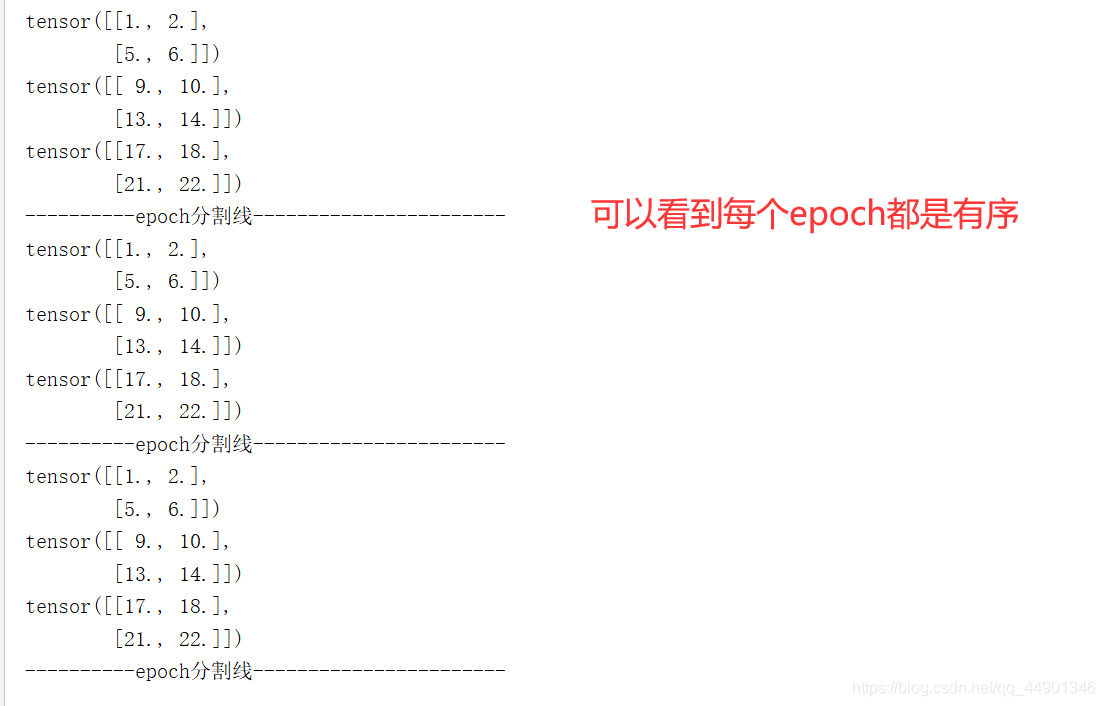
pytorch 的 DataLoader中的shuffer与随机种子-python黑洞网
Pandas - How to shuffle a DataFrame rows - GeeksforGeeks Shuffle the rows of the DataFrame using the sample () method with the parameter frac as 1, it determines what fraction of total instances need to be returned. Print the original and the shuffled DataFrames. # import the modules import pandas as pd import numpy as np # create a DataFrame ODI_runs = {'name': ['Tendulkar', 'Sangakkara', 'Ponting',
python - LSTM Keras input shape confusion - Stack Overflow
Shuffle, Split, and Stack NumPy Arrays in Python | Python ... First, split the entire dataset into a training set and a testing set. Second, split the features columns from the target column. For example, split 80% of the data into train and 20% into test, then split the features from the columns within each subset. # given a one dimensional array

Practical RDD transformation: repartition in PySpark using Jupyter Notebook | PySpark 101 | Part 21
python - Loading own train data and labels in dataloader ... I have a dataset that I created and the training data has 20k samples and the labels are also separate. Lets say I want to load a dataset in the model, shuffle each time and use the batch size that I prefer. The Dataloader function does that. How can I combine and put them in the function so that I can train it in the model in pytorch?

python - How to train a tensorflow model to accurately classify open eyes and closed eyes ...
numpy - How to randomly shuffle data and target in python ... If you're looking for a sync/ unison shuffle you can use the following func. def unisonShuffleDataset (a, b): assert len (a) == len (b) p = np.random.permutation (len (a)) return a [p], b [p] the one above is only for 2 numpy. One can extend to more than 2 by adding the number of input vars on the func. and also on the return of the function.
Post a Comment for "45 shuffle data and labels python"